
Beauty & The Streets | Why I Still Shoot Street Photography
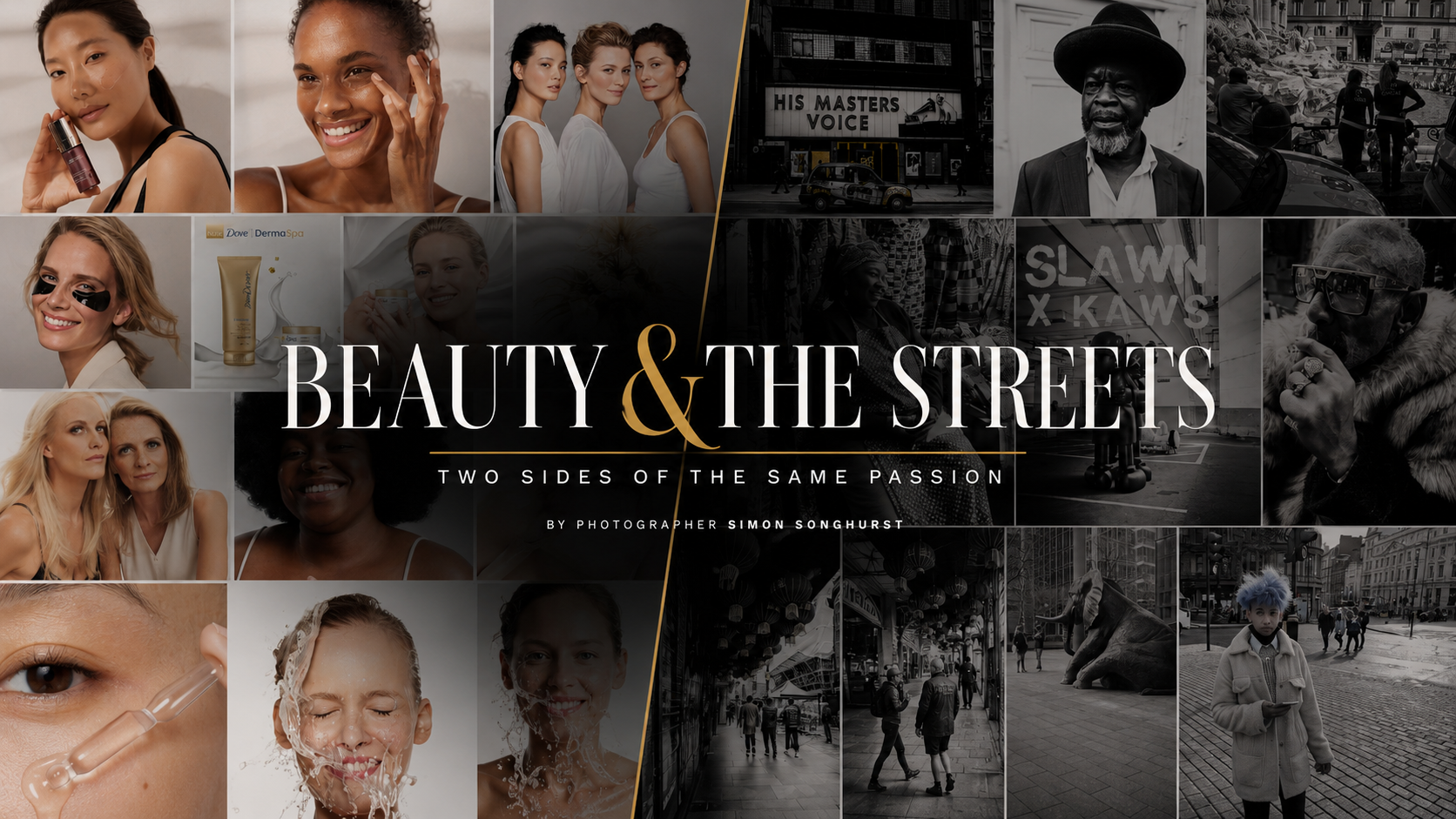
Two very different sides of the same photography career.
I have spent most of my professional life trying to control photographs. Street photography gives me the opportunity to do almost exactly the opposite.
I've been a professional photographer for more than 25 years, and a large part of that career has been spent photographing beauty, skincare and hair. It is a world where details matter. Light is placed deliberately. Hair is styled. Skin is considered carefully. Products, backgrounds, expressions and composition all have a purpose. There is normally a brief, a client, a team and ultimately an image that needs to do a job.
I still love that process. There is something enormously satisfying about taking all of those separate elements and gradually bringing them together into a finished photograph.
But when photography has been your profession for a long time, something interesting happens. The thing you originally picked up a camera to do for yourself can very easily become something you only do for other people.
That's where the streets come in.
“On the street there is no brief, no client and no predetermined photograph. There is just whatever happens next.”
Simon SonghurstWhen photography becomes the job
Making a living from something creative is a privilege, but it inevitably changes your relationship with it.
A commercial photograph has a purpose before I press the shutter. Even when there is room for experimentation, I'm working towards something. A campaign needs to communicate. A skincare image needs to make skin and product feel believable and desirable. A beauty photograph needs to satisfy both a creative idea and a commercial requirement.
Years of doing that teaches you discipline. You learn to solve problems. You learn how tiny changes in light, expression, framing or colour can completely alter an image.
What it doesn't necessarily give you is the freedom to make a photograph for absolutely no reason other than the fact that you noticed something.
Street photography gives me that back.
Beauty
Beauty and skincare photography is about refinement. My professional work is built around light, skin, texture, expression and detail. Sometimes the image may look effortless, but achieving that simplicity usually requires a great deal of control behind the camera.
It's collaborative photography. Models, hair and make-up artists, stylists, agencies, clients and production all contribute to what eventually exists inside the frame.
I know why I'm there and what I'm trying to create.
View my beauty & skincare work →The Streets
Street photography removes most of that structure. I can leave home with a small camera and no particular photograph in mind. Nobody is waiting for anything. Nothing needs approving.
Instead of constructing the image, I'm looking for it. A gesture, an expression, an odd juxtaposition, somebody disappearing through a patch of light, or simply a moment that feels worth remembering.
I don't know what I'm going to photograph. That's precisely the point.
Explore my street photography →One of the things I enjoy most about walking with a camera is that it changes the way I look at somewhere. I'm not simply walking from one place to another. I'm looking at people, reflections, architecture, light, signs, colours and all the strange little interactions happening around me.
You begin to notice things that would otherwise be incredibly easy to walk straight past.
For me, that's one of the real benefits of street photography. The photograph is important, but so is the process of looking for it.
It also gets me out walking. A camera gives the walk a purpose without turning it into a job. I can spend hours wandering through London or through a city when I'm travelling and barely think about the distance I've covered because I'm continually looking for the next frame.
Sometimes I come back with something I really like. Sometimes I don't. Unlike a commissioned shoot, either outcome is perfectly fine.
Beauty taught me how to control a photograph. The street keeps teaching me when to let go.
Beauty & The Streets — Simon Songhurst
Two disciplines that aren't as different as they first appear
On the surface, my commercial beauty work and my street photography could hardly look more different.
One can involve lighting, production, retouching and a carefully controlled environment. The other might be me walking through a city with one small camera and reacting to something that exists for a fraction of a second.
But underneath that, I think they exercise many of the same instincts.
You're still looking at light. You're still watching people. You're still thinking about the edges of the frame. You're still waiting for expression, body language and small details to fall into place.
The difference is the amount of control you have over them.
Why a small camera matters
Over time I've become increasingly interested in keeping my personal photography simple. The less equipment I carry, the more likely I am to actually have a camera with me.
That's particularly important with street photography. I don't want the process to feel like I'm heading out on another production. I want to be able to walk, react and photograph without thinking too much about the equipment.
There is also something useful about having limitations. One camera and one lens removes decisions. Instead of thinking about what equipment I should be using, I'm thinking about what is happening in front of me.
After spending a working life surrounded by cameras, lenses, lighting and production equipment, there is something wonderfully refreshing about that.
Travel makes the process even more interesting
Street photography naturally follows me when I travel. A new city gives you an immediate visual awareness because almost everything is unfamiliar. The architecture changes. The light changes. People behave differently. Even ordinary things become interesting simply because they're not part of your normal surroundings.
I enjoy photographing the obvious landmarks, but the pictures that usually interest me most are found around them — the people waiting, working, smoking, talking, eating, watching or simply passing through.
They're small fragments of somewhere rather than an attempt to explain the whole place.
“The camera gives me a reason to keep walking, but the walking gives me the photographs.”
Simon SonghurstNot every photograph needs to become content
This has probably become more important as photography, filmmaking and online content have increasingly overlapped in my working life.
There is now an almost automatic temptation to ask what something is for. Is it a video? A post? A review? A tutorial? Does it belong somewhere online?
Street photography reminds me that a photograph doesn't necessarily need another purpose.
Some pictures will end up on my website. Some may become part of a video or a larger project. Others may sit quietly in an archive.
They were still worth making.